xTAK is a suite of seven independent services that extend ATAK, WinTAK, and iTAK to the places the official clients can't reach: amateur radio, LoRa mesh, off-grid Wi-Fi, SDR-decoded aircraft, browser endpoints, and AI helpers. Self-hosted. Backpack-portable. The whole suite fits in a Pelican case.
A regional disaster response. The state EOC has lost the WAN. Cellular is intermittent across three counties. Three SAR teams are in the field; two carry ATAK tablets, the third is volunteers running phones they brought from home. A mutual-aid air asset is inbound. The state EOC five hundred miles away wants to share the picture.
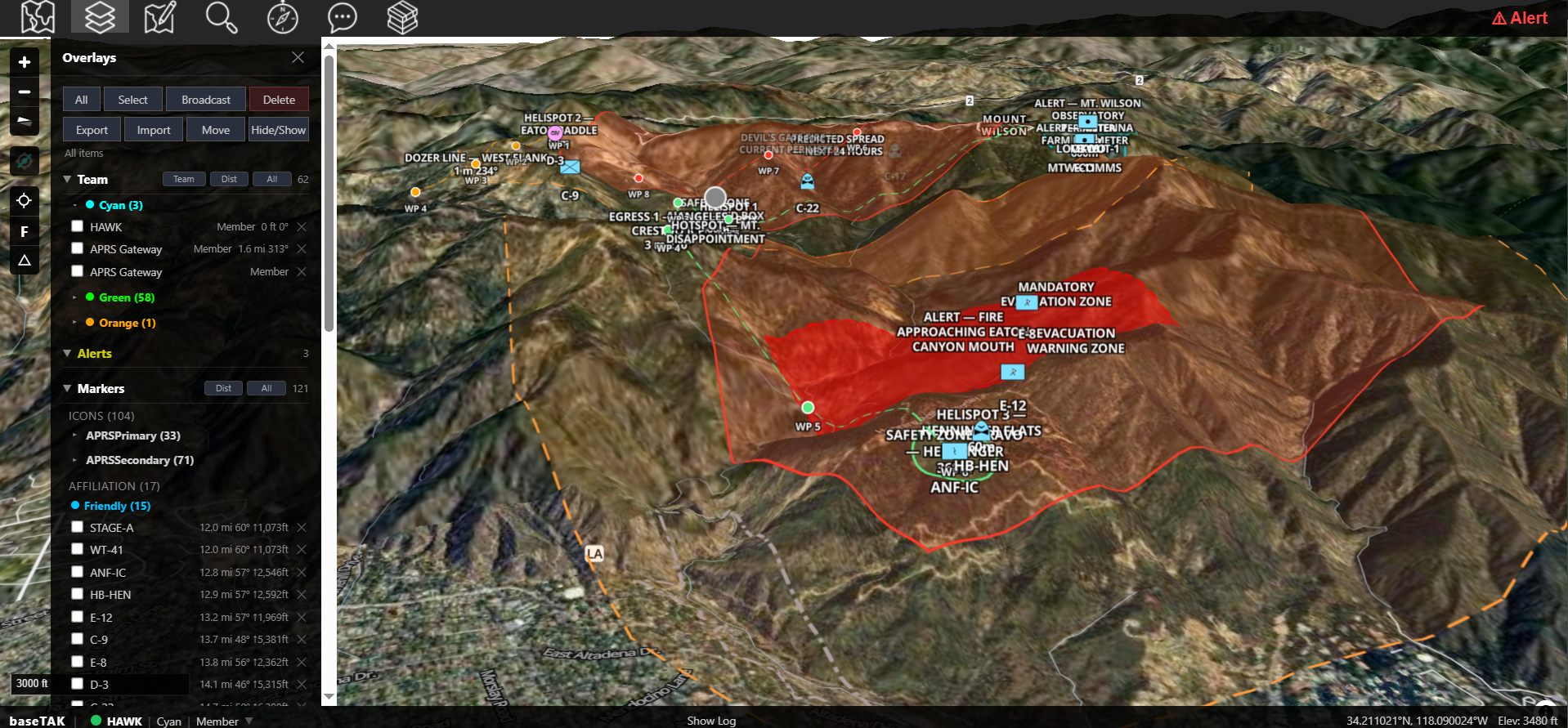
A baseTAK at the EOC serves the IC's web map. She runs the operation from a laptop. Two clicks to drop a marker. A digiTAK in the next rack federates the EOC with the state ARES net over HF and the regional APRS network over VHF — simultaneously.
A loraTAK at a remote staging site puts every volunteer's Meshtastic node on the IC's map. A chatTAK in the parking lot at a shelter checks in walk-up volunteers in sixty seconds — each becomes a first-class TAK contact, no app install. An sdrTAK at the airport feeds inbound mutual-aid helicopter positions onto every map in the network.
One TAK picture. Seven products. No TAK Server. No cloud. No internet uplink.
That's xTAK.
Every product works standalone. Together they compose on one TAK network — no glue, no integration tax. Pick the radio, pick the role, drop it on the LAN.
Run the operation from a browser. Full TAK map, chat, and SA hub in a tab — faster than WinTAK by design.
TAK on the air. VHF for the region, HF for the continent, APRS-IS for the internet — all simultaneously.
Your Meshtastic mesh, now a TAK network. Every node a first-class chat-able contact.
Comms-forward TAK on an appliance. Multi-user — the whole command staff runs from one box, no app required.
Every aircraft in the sky. Every ship in the bay. SDR-decoded ADS-B, UAT, and AIS as native TAK contacts.
A self-managing wireless mesh for field-deployable TAK operations. Drop an appliance at every site, they auto-form a mesh. TAK clients connect like to any Wi-Fi.
A local-first LLM that joins your TAK network as a peer. Drafts SITREPs, answers questions, flags conditions.
Support the project on Buy Me a Coffee — get every xTAK Beta build, every new feature, and direct engagement with the team before public release.
Every product is a complete service. They discover each other and trade data over standard TAK protocols. No glue. No integration tax. No shared database.
Built to run without internet, without cellular, without TAK Server. Cloud is an option, not a requirement. Offline tarball installs with vendored dependencies.
What xTAK emits on the wire is byte-identical to what WinTAK emits. Markers, chat, SA, team color, custom icons — full fidelity through every product.
Standard TAK protocol on the wire. No subscription, no per-device licensing, no cloud account. The data is yours, the boxes are yours.
Designed by and for the people who actually run operations. Faster click paths, fewer menus, less clutter — the map gets the screen.
None of this lives in a server rack. baseTAK on a Game Boy-sized device. chatTAK smaller than a deck of cards. The whole suite fits in a backpack.
Every xTAK product is a standalone service. They compose by sharing one thing: the standard TAK network on the LAN. TAK clients on top, the network in the middle, xTAK gateways underneath — each reaching out to whatever its world is (radio, LoRa, SDR, browser, AI).
Each product ships as an independent install — offline tarball, single install script, settings-file configuration. Drop them on a shared LAN; they discover each other.
The suite is in active development. Two products are in Beta and shipping now: digiTAK (APRS / APRS-IS) and sdrTAK (aircraft tracking). Four products (baseTAK, chatTAK, loraTAK, netTAK) are in active development with Beta release TBD. One product (aiTAK) is in design phase. Early Adopters get access to every product as it reaches Beta.
No. Every xTAK product joins the local TAK network directly and talks to ATAK, WinTAK, and iTAK clients without any server. TAK Server is the official cross-WAN federation product from the TAK Product Center; xTAK solves that problem differently — over RF, mesh, and HF — without it.
Yes. xTAK speaks the same TAK protocol all builds use — military, civilian, and the open community variants.
Two ways. Install the xTAK software on your own hardware — small Linux device (4 GB+ RAM, fanless mini-PC, or handheld Linux box) — or order a ready-to-deploy xTAK appliance from us. Either way, the software runs on your network and your data stays on your hardware. Early Adopters get Beta build access by supporting the project on Buy Me a Coffee.
Yes. The TAK-APRS Protocol Extension v2.3 we designed is published openly. xTAK products speak standard TAK protocols on the LAN (CoT XML, GeoChat, TAK protobuf) so any TAK client can join the picture.
Only digiTAK can require a license — and only when you operate it on amateur radio bands. digiTAK also supports non-amateur bands; whatever licensing applies to those bands applies to you. baseTAK, loraTAK (Meshtastic on unlicensed ISM bands), chatTAK, sdrTAK (receive-only), and aiTAK require no license.
Buy Me a Coffee. Early Adopters get Beta access to all xTAK software, new features, and direct engagement with the team. The project is self-funded — supporter contributions fund the next product and the next deployment test.
Yes. Composability through the TAK network is a hard design rule — every product runs on its own and discovers the others via standard TAK protocol. There is no integration tax, no shared module, no required hub.
Yes. xTAK joins as a peer. If you already run TAK Server for WAN federation, xTAK runs alongside it; if you don't, xTAK gives you off-grid alternatives.