PRODUCT / AITAK LLM · ON-NETWORK
STATUS / DESIGN STAGE / ARCHITECTURE
xTAK / Products / aiTAK
Design phase · release planned

An AI assistant
that lives inside
your TAK network.

An LLM on your network. Your hardware. Your data. Never anyone's cloud. aiTAK joins your TAK network as a peer, watches the picture as it evolves, and answers questions, summarizes activity, drafts chat, and flags conditions that match operator- defined rules — running on your own hardware, in your own deployment.

Incident CommandersPlanning Section ChiefsSAR Operations ChiefsEOC StaffMulti-day ActivationsTraining CoordinatorsData-Sovereignty Ops
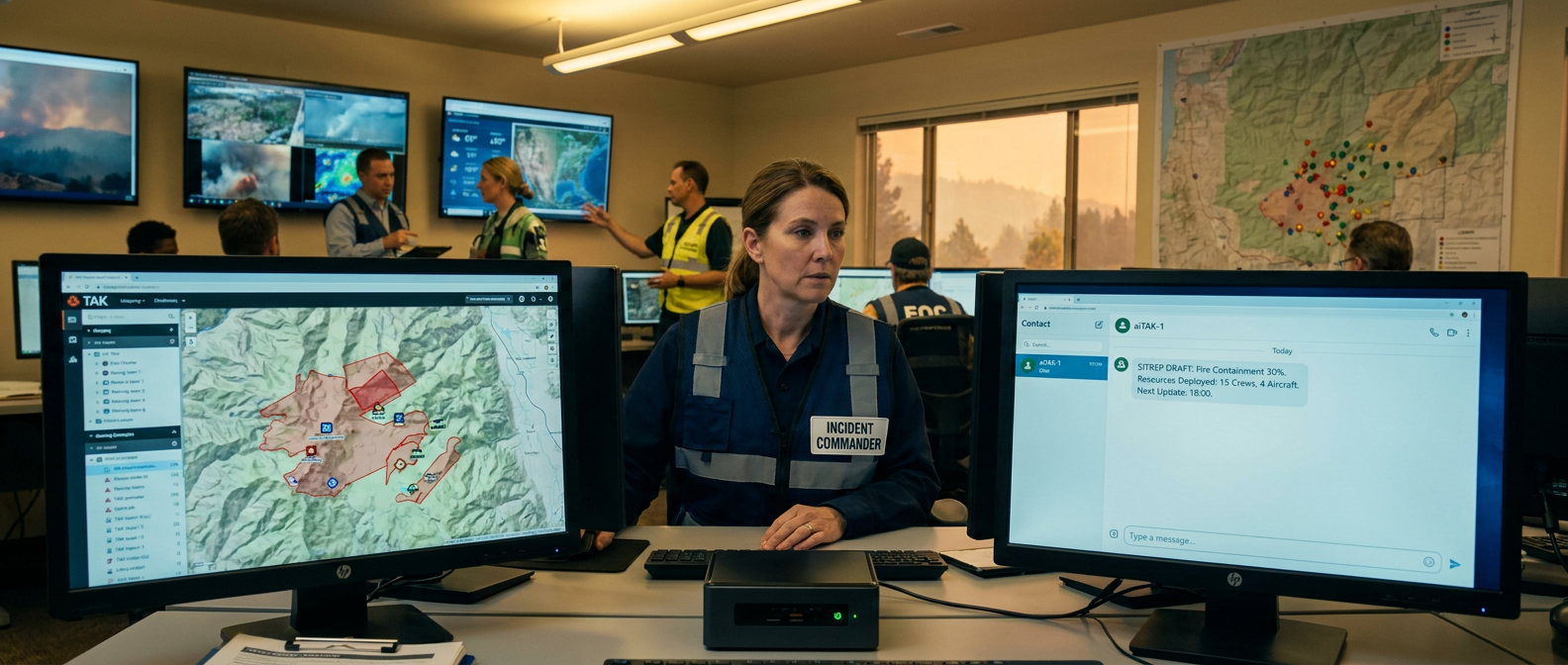
aiTAK at a regional EOC — incident commander in ICS vest at a desk with two monitors, left monitor showing a TAK map with fire perimeter, right monitor showing a chat with aiTAK drafting a SITREP, mini-PC visible on the desk
AITAK · EOC · LLM ON THE NETWORK aiTAK at an active-incident EOC — the IC's left monitor shows the TAK map, the right monitor shows a chat thread with aiTAK drafting a SITREP from observed activity. The mini-PC running the model sits on the desk. Local-first, no cloud.

Hour four of a
multi-agency response.

It's hour four of a multi-agency wildfire response. The IC has three operations sections, two air assets in the box, four ground crews, and a planning meeting in twenty minutes. Her WinTAK is dense with markers — staging areas, hot spots, structure threats, drop points, hazard zones, four kinds of overlay.

She opens a chat thread with aiTAK-1 from her WinTAK.

"summarize the last hour by sector"

aiTAK posts a four-bullet brief in chat: spread direction by sector, structures newly threatened, air-asset activity, ground-crew positions. Each bullet links to the relevant markers on her map.

"draft the 1400 IAP planning brief"

aiTAK drops a draft into chat, structured to her unit's IAP template, pre-populated with the position and activity data it observed over the last shift.

While she's reviewing the draft, aiTAK posts on its own:

"A ground crew has been stationary for 22 minutes inside the hot-zone polygon you drew at 10:14. Their last chat said 'taking ten.' Possible heat exhaustion. Suggest comms check."

She DMs the crew lead. They're fine — but she didn't have to be the one watching.

An LLM that has been on the network the whole time, watching what every operator was watching, and helping.
Four things
aiTAK will do.

OUTCOME 01

Ask the operational picture questions in plain English

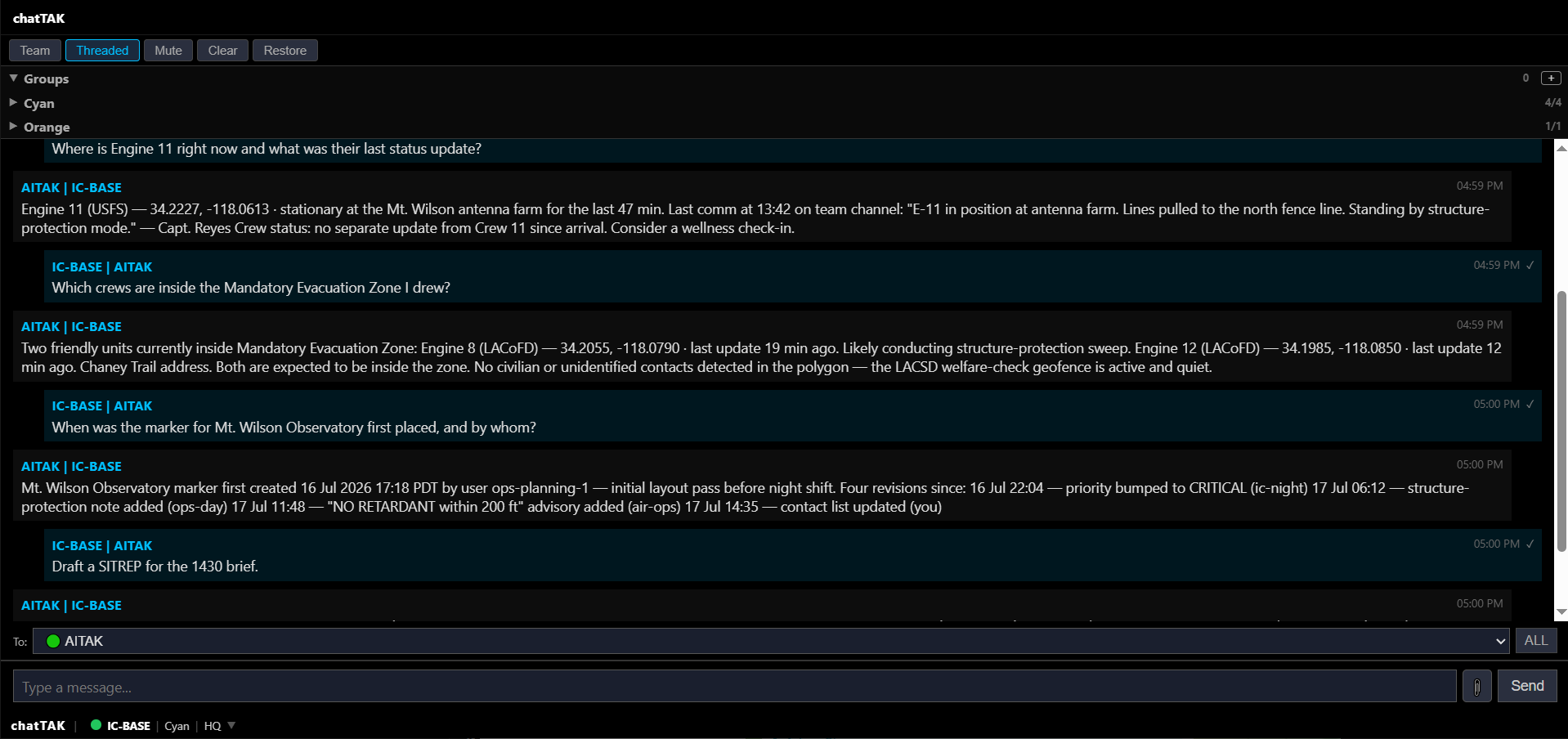
aiTAK has been on the TAK network since the start of the deployment. It has the full COT history, the chat log, the marker placements, the team movements, and the timestamps.

  • "Summarize the last hour by sector."
  • "When was the structure marker at Smith Road first dropped? By whom?"
  • "Where is Engine 3 right now and what was their last status update?"
  • "Which crews are inside the evacuation zone I drew?"
  • "Draft a SITREP for the 1400 brief."
A TAK chat panel showing a natural-language Q&A thread with aiTAK during the Devil's Gate Fire — an operator asks 'Summarize the last hour by sector,' 'Where is Engine 11 right now,' 'Which crews are inside the Mandatory Evacuation Zone I drew,' 'When was the marker for Mt. Wilson Observatory first placed and by whom,' and 'Draft a SITREP for the 1430 brief,' with structured operational responses from aiTAK citing specific units, coordinates, timestamps, and revisions
OUTCOME 02

Watch the conditions an IC shouldn't have to watch personally

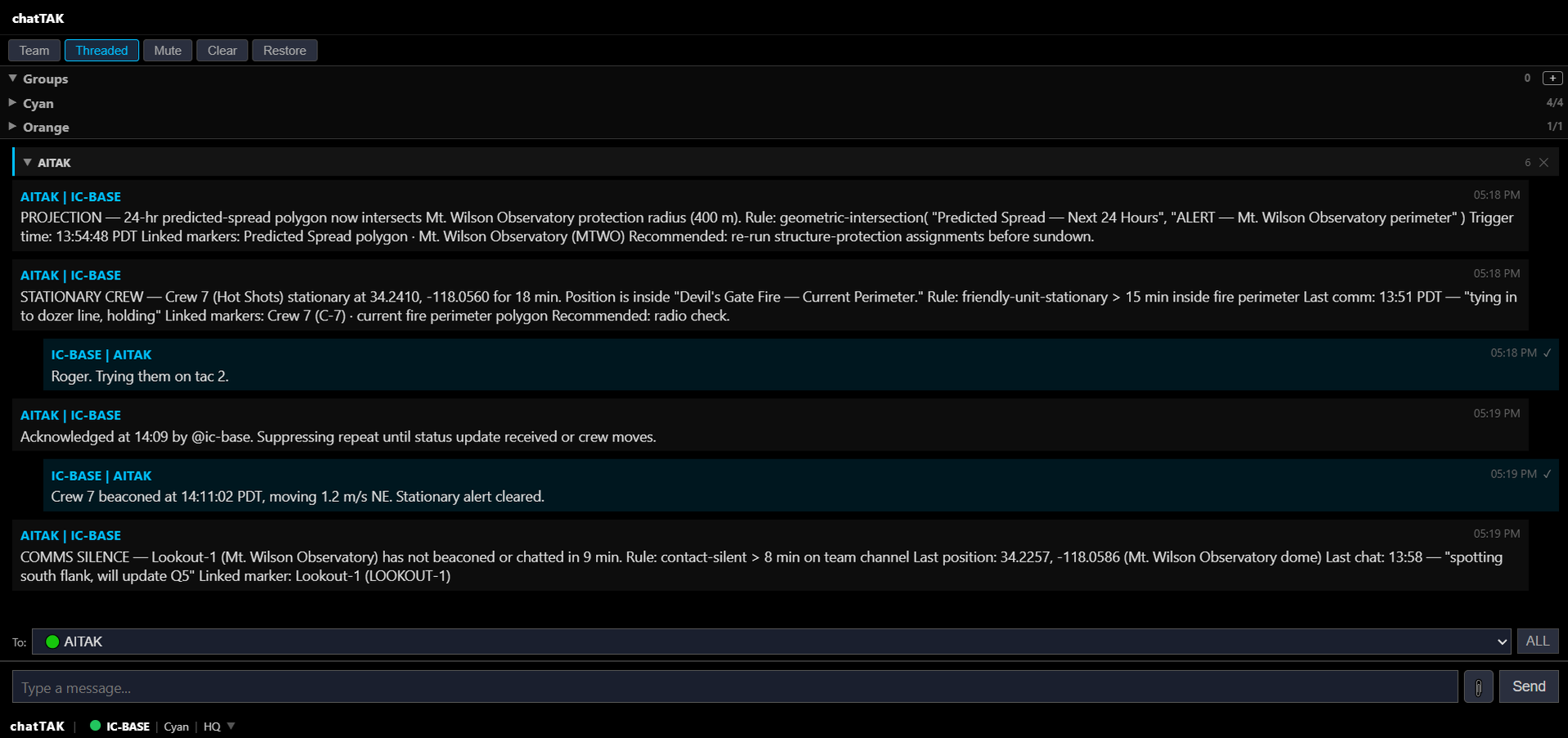
Operator-defined rules let aiTAK monitor for conditions that an IC shouldn't have to watch personally.

  • Stationary-team alerts — flag a team that hasn't moved in N minutes inside a hazard polygon.
  • Geofence breaches — alert when any contact crosses an operator-drawn boundary.
  • Comms-silence alerts — flag a contact that hasn't beaconed or chatted in N minutes.
  • Pattern recognition — flag combinations of conditions (low battery + entering hot zone).
  • Alerts post as TAK chat from aiTAK's TAK identity — ICs can DM aiTAK for more context.
A TAK chat panel showing aiTAK running as a watchful background participant during the Devil's Gate Fire — automatic alerts fire as conditions trigger: a PROJECTION that the 24-hour predicted-spread polygon intersects the Mt. Wilson Observatory protection radius, a STATIONARY CREW alert on Crew 7, IC-base acknowledging on tac 2, aiTAK self-muting and then auto-resolving when the crew moves, and a COMMS SILENCE alert on Lookout-1
OUTCOME 03

Draft, summarize, translate

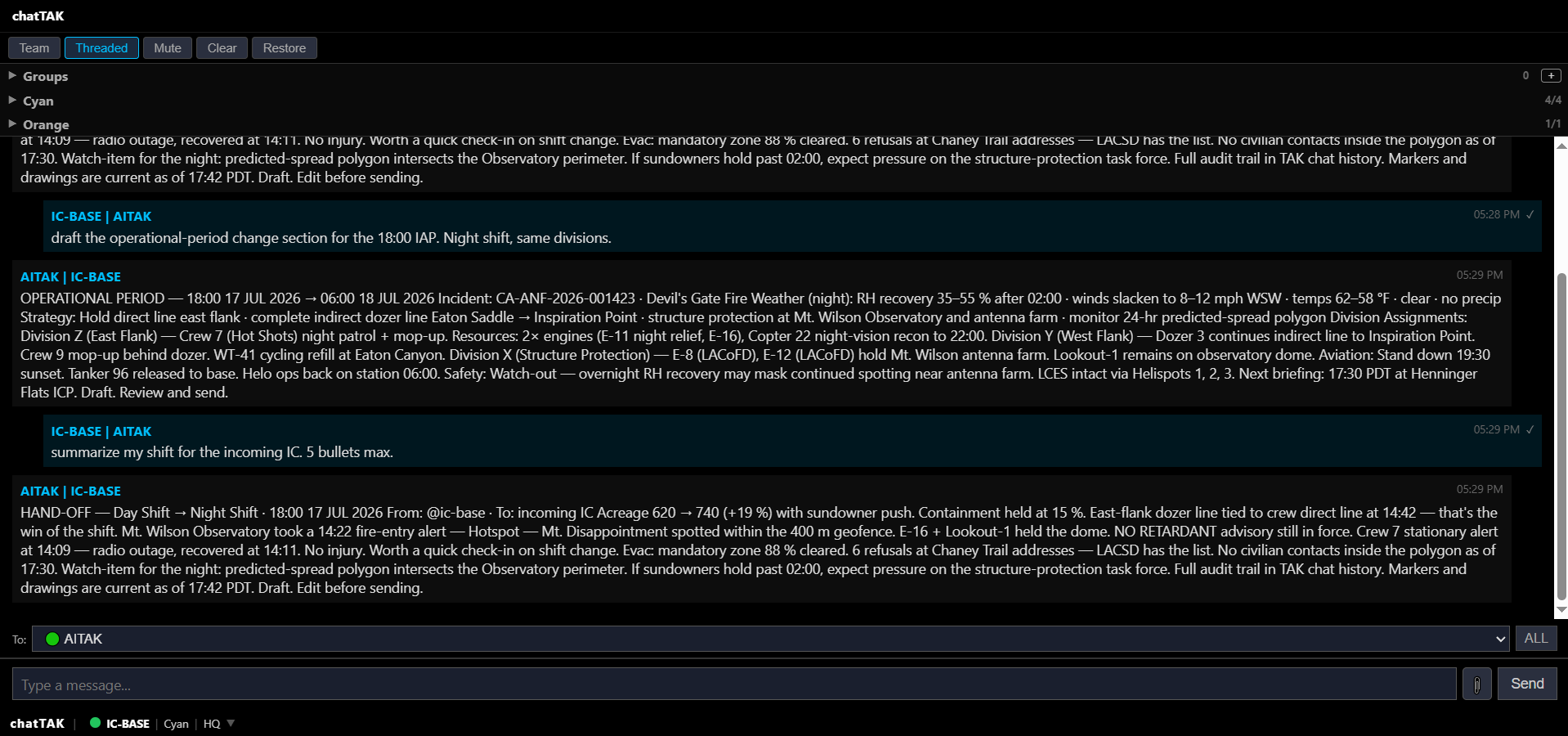
Anything you'd ask a junior planning officer to bang out, aiTAK can draft. The operator stays in the loop — aiTAK produces drafts; humans send them.

  • IAP / SITREP drafts from observed activity.
  • End-of-shift summaries for hand-off briefs.
  • Chat-to-radio translation drafts — formalize an informal chat into a clean radio-traffic script.
A TAK chat panel showing aiTAK producing structured drafts on request — an Operational Period change for the 18:00 IAP with division assignments, an end-of-shift hand-off summary in five bullets for the incoming IC, and a clean radio-traffic translation of an informal chat about a Tanker 96 retardant-drop assignment
OUTCOME 04

Run on your own hardware, your own data

aiTAK is built to run locally — on a workstation with a consumer GPU, or on a server with proper inference hardware, or on a small mini-PC for 8B-class models. It does not send the operational picture to anyone's cloud.

  • Local-first, by design — sensitive operational data never leaves the deployment.
  • Bring-your-own-model — open-weights LLMs (Llama, Qwen, Mistral, etc.) supported via OpenAI-compatible local inference (llama.cpp, vLLM, Ollama, LM Studio, TGI).
  • Solar-viable for 8B-class models — sub-150 W power draw on consumer hardware. Multi-day field deployments are practical.
  • No subscription, no API keys — your hardware, your inference, your costs.
  • Audit log — every aiTAK response is logged with the prompt, the model, and the data it referenced.
A small compact mini-PC sitting on a folding camp table at a remote field operations site, plugged into a portable solar panel and battery, connected to a rugged tablet displaying a TAK map. A wildland firefighter in yellow Nomex consulting the tablet, with distant wildfire smoke and mountain terrain in the background

What's in the box. ★ Design phase — release timing TBD

aiTAK is an AI agent that participates in the TAK picture as a first-class contact. Operators chat with it via native GeoChat to query the SA picture, ask for summaries, request CoT generation, or task it to monitor specific feeds. The capability list below is the design target.

★ Choose aiTAK when

Hour four of a multi-day response. Three sections, four crews, a planning meeting in twenty minutes. The IC needs a SITREP draft, a sector summary, and an extra set of eyes. An LLM that's been on the network the whole time. Currently design phase — release timing TBD; the positioning above is the design target.

☕ Future release · Get notified

Be first when aiTAK ships.

aiTAK is the most experimental product in the xTAK suite. Architecture is being prototyped; first public release timing TBD. Early Adopters get access the moment a Beta build is ready.

Support on Buy Me a Coffee

What aiTAK will use.

— The positioning here is the design target. Initial release will be a subset, with capabilities added incrementally.

8B-class model
Small mini-PC, Apple Silicon Mac mini, Jetson, or any consumer machine with enough VRAM. Llama 3.1 8B, Qwen-class, Mistral. Typically sub-150 W draw — solar-viable for multi-day field deployments.
70B-class model
Workstation hardware (RTX 4090 / 5090, dual-3090, M-series Mac Studio) when the operation can spare the power budget
Server hardware
H100 / A100 / L40S supported but not required
Inference backend
Any OpenAI-compatible local server — llama.cpp, vLLM, Ollama, LM Studio, TGI
Model licensing
Bring your own open-weights model · no subscription, no API keys
Network
A TAK LAN — same one your ATAK / WinTAK / baseTAK is on. aiTAK joins as a peer with its own UID, callsign, team, SA heartbeat.
Cloud
Not required · No OpenAI, no Anthropic, no Google — unless you choose to use one
Internet
Not required (once the model is downloaded)
Audit
Every response, every alert, every rule trigger logged with prompt, model, data references, and timestamp

Questions
operators ask.

Does aiTAK send my operational data to a cloud LLM?

No — local-first by design. Sensitive operational data never leaves the deployment. The LLM, the embeddings, the chat history, the COT log — all stays on your machine. You can choose to use a cloud LLM, but it's not the default and not required.

What models can aiTAK use?

Bring your own open-weights LLM via any OpenAI-compatible local inference server (llama.cpp, vLLM, Ollama, LM Studio, TGI). Llama 3.1 8B, Qwen-class, Mistral are good 8B-class candidates. 70B-class models work on workstation hardware.

Can I run aiTAK in the field?

Yes — that's the design target. An 8B-class model runs on consumer hardware with sub-150 W power draw, which is solar-viable for multi-day field deployments. A small mini-PC at an EOC handles most realistic field scenarios.

How does aiTAK appear on the TAK network?

As a TAK peer. aiTAK has its own UID, callsign, team color, and SA heartbeat. ICs can DM aiTAK from any TAK client like any other contact. Alerts post as TAK chat from aiTAK's identity.

Can I write my own alerting rules?

Yes. Operator-authored rules in a small DSL evaluate against the live TAK stream. Stationary-team alerts, geofence breaches, comms-silence alerts, and combination patterns are the initial primitives. The audit log captures every rule trigger.

Why does this matter for agencies with data-sovereignty requirements?

Cloud LLM services (OpenAI, Anthropic, Google) require you to send the operational picture out to a third party. For agencies and operations where that's not legally or operationally acceptable, aiTAK is the local-first alternative — the LLM runs on your hardware, the data stays in your deployment.

When is aiTAK shipping?

aiTAK is the most experimental product in the xTAK suite. Architecture is being prototyped; first public release timing is TBD. The positioning described here is the design target — the actual first-release feature set will likely be a subset, with capabilities added incrementally.