PRODUCT / DIGITAK CODENAME / cot_radio
STATUS / BETA v 2.1.12
xTAK / Products / digiTAK
Beta · shipping now (APRS / APRS-IS)

TAK on the air.
VHF for the region.
HF for the continent.

Two radios. One appliance. The whole continent on the same picture. Federate two or more TAK networks over amateur radio — VHF for regional reach, HF for the continent — both transports simultaneously from a single gateway. Built for EmComm, SAR, ARES districts, and any team that has to coordinate when the WAN is gone.

ARESRACESACSSATERNMARSSARPublic-Safety AuxcommAmateur Radio
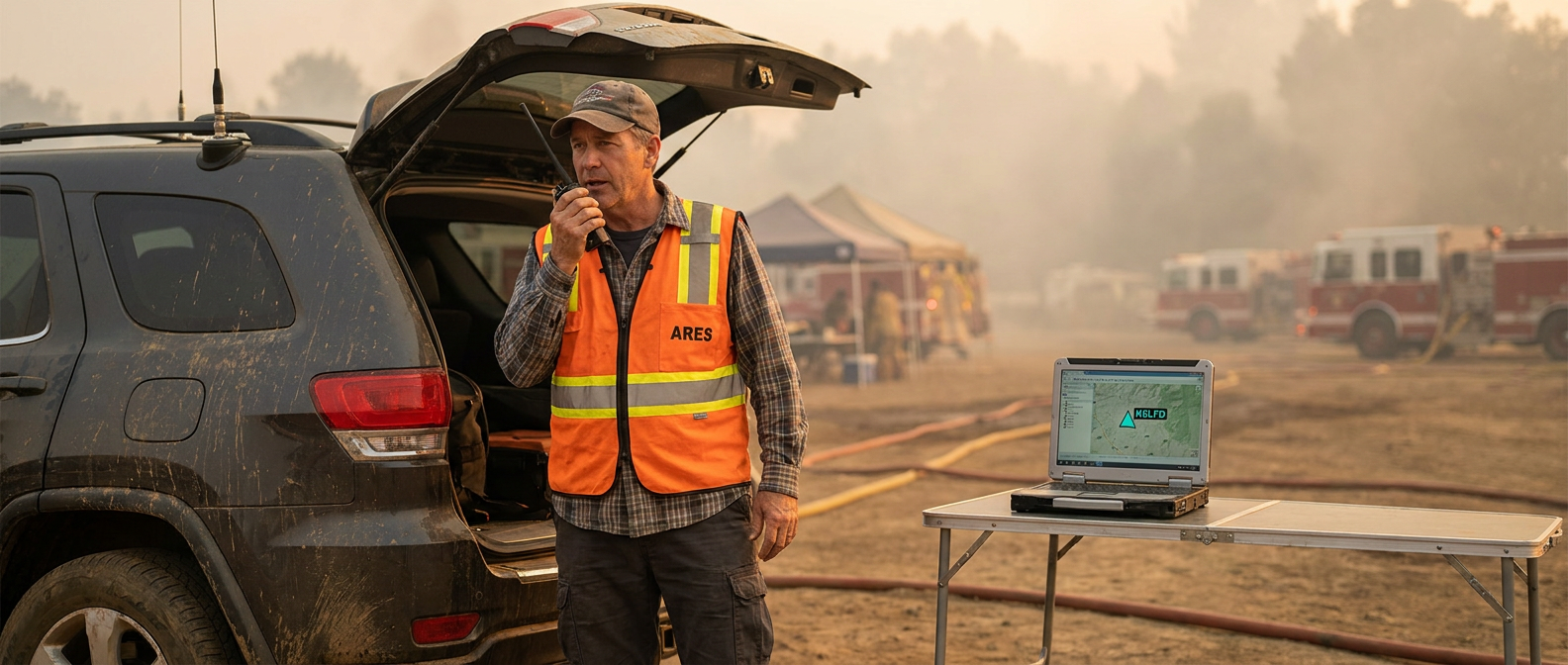
digiTAK in the field — appliance-based gateway on the tailgate of a fire-response truck with VHF/HF radio and antenna mast, firefighter at a rugged laptop showing TAK map with fire perimeter, San Gabriel Mountains in the background
DIGITAK · FIELD STAGING · GOLDEN HOUR digiTAK on the tailgate of a fire-response truck — appliance gateway, VHF and HF radios, antenna mast, and a WinTAK laptop showing the live TAK picture. Same digiTAK reaches the next county on VHF, the next state on HF, simultaneously.

Day two of a
multi-day exercise.

The forward team is up a fire road with no cell, no Starlink, no LTE. Base camp is forty miles back. Both teams need to be looking at the same picture.

You drop a digiTAK at each site. A VHF antenna on a mast. The map on the IC's WinTAK at base camp shows the forward team's markers within seconds. The forward team's ATAK tablets see the IC's search grid the moment it's drawn. When a volunteer with an APRS rig drives in from the highway, their callsign appears on every TAK client on the network as a chat-able contact.

Meanwhile, the state EOC five hundred miles away has its own digiTAK with an HF rig. The duty officer there sees the exercise's team positions on her WinTAK — passed across the ionosphere by your digiTAK's second radio port. She can chat with the field IC over HF.

Same digiTAK. Both radios. Simultaneously.

No internet. No TAK Server. No cellular. Just amateur radio and an appliance at each end.

Drop a digiTAK in.
Instantly an APRS gateway.

digiTAK runs on its own appliance. Plug it onto any network and the LAN gains a full APRS gateway — every ATAK, iTAK, WinTAK, or baseTAK browser picks up APRS stations as native TAK markers, and every marker, chat, or shape goes back out onto RF. No glue, no integration; just standard TAK protocols on the wire.

BRIDGE MODE

Alongside the
xTAK suite.

Drop a digiTAK onto a network where baseTAK and the rest of the xTAK suite are already running. It joins like any other TAK contact and becomes the APRS gateway for the whole picture. Standard TAK protocols — no special configuration on either side.

STANDALONE MODE

digiTAK alone is
the whole install.

Drop a digiTAK onto a bare network — no baseTAK anywhere on the wire. digiTAK hosts its own chat router and TAK router; every ATAK / WinTAK / iTAK on the LAN connects directly and sees both the local team and APRS contacts from the wider world. The whole TAK environment fits on one appliance.

Five things
digiTAK does well.

OUTCOME 01

Federate N sites into one TAK picture over RF

In bridge mode, multiple digiTAK gateways form a federated mesh over RF or APRS-IS. Markers placed in ATAK at site A appear in WinTAK at site B with full TAK fidelity — team color, role, COT type, custom icons all preserved.

  • Add a digipeater between sites to extend RF reach via existing APRS infrastructure.
  • Add another digiTAK to grow the operating area.
  • Sibling-gateway coexistence — any number of digiTAKs can share an RF channel without re-emitting or re-digipeating each other's traffic. (Standard channel collisions still apply — half-duplex RF is half-duplex RF.)
  • Open wire spec — third-party gateways can interoperate.
Tactical schematic showing three digiTAK sites (A, B, C) in a bridge-mode federation — sites A and B connected by a short RF hop, sites B and C connected through a digipeater node. Each site's TAK network cloud shows the synchronized marker.
OUTCOME 02

digiTAK + baseTAK: the richest APRS map on any modern client

digiTAK + baseTAK is the richest APRS picture on any modern map. Every APRS station renders with its proper APRS icon — not a generic dot — and you can filter the map down to just the device type you care about with a click.

  • Full APRS icon set on the map — every primary and alternate APRS symbol renders as a proper TAK icon. Digi, mobile, weather, ambulance, fire engine, boat, aircraft, NWS object — every device type you'd expect, on a modern pan-zoom-search map.
  • Filter by APRS device type — baseTAK's map filter isolates the symbols you care about. Show only weather stations during a SKYWARN net, only mobile trackers during a race, only digipeaters during a band test, only NWS bulletins during severe weather.
  • DM a callsign from any TAK client; the message lands on RF or APRS-IS.
  • Weather stations and NWS bulletins appear as native TAK overlays.
  • Reach amplified by APRS digipeaters — your TAK network's reach becomes whatever the global volunteer digipeater infrastructure can carry, often dozens or hundreds of miles beyond your own line of sight.
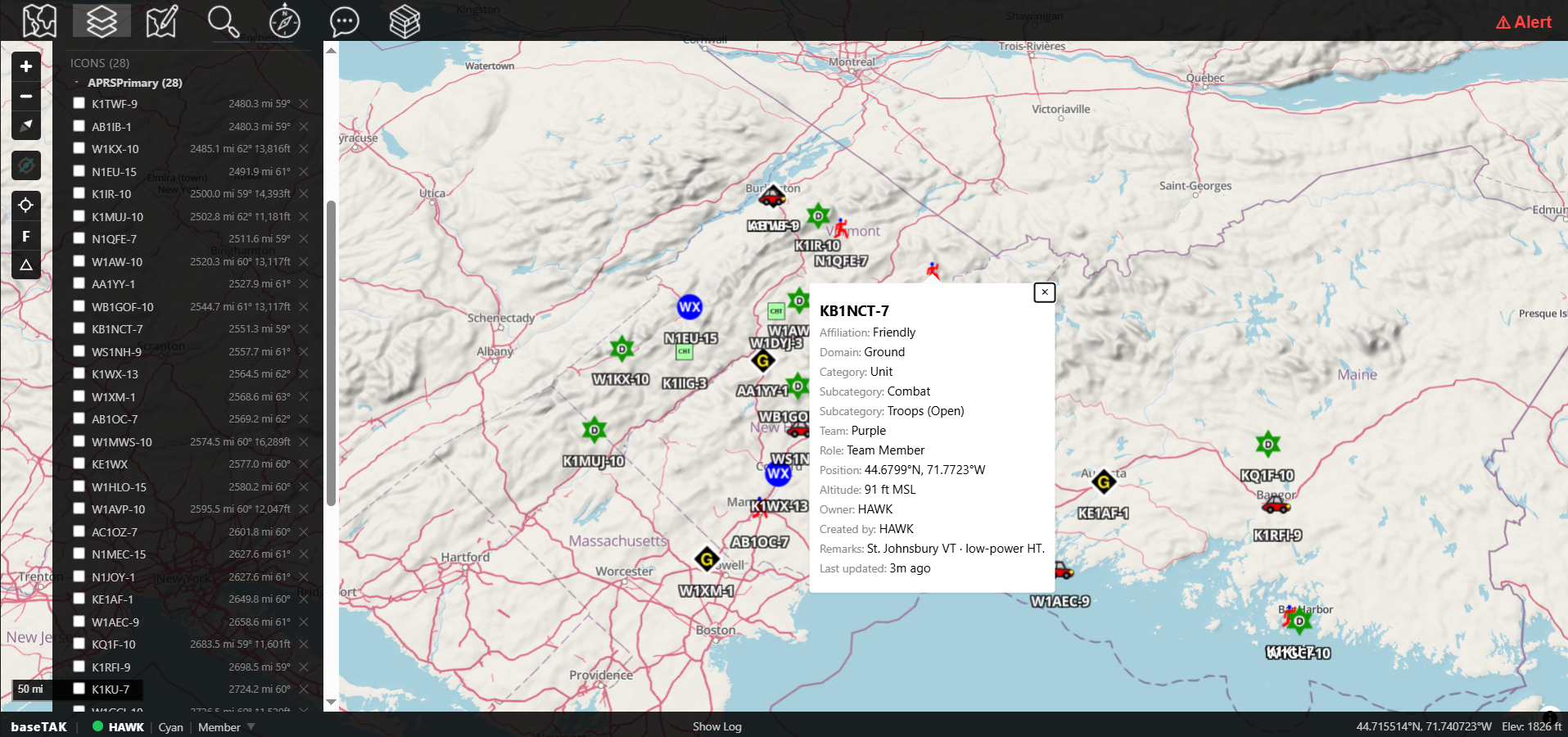
A baseTAK terrain view of Northern New England with 30 APRS station contacts pulled in via digiTAK — mountaintop digipeaters, weather beacons, vehicle and HT trackers across VT, NH, and ME — with a marker info card open for KB1NCT-7 (low-power HT in St. Johnsbury VT) and a left rail listing every callsign
OUTCOME 03

Bring APRS-only hams into the operation — no app, no new gear

An operator with nothing more than an APRS-capable radio participates fully in the TAK operation. They see the picture, they're seen, and they chat — all over APRS, no TAK client required. No app. No new gear. No new training.

  • They appear on TAK clients as native TAK contacts — position on the IC's WinTAK, bulletins in TAK chat, callsign attribution preserved end-to-end.
  • They see the TAK operation on their APRS gear — TAK users' positions are broadcast out to APRS as standard objects, so the ham with just a handheld and an APRS map display sees the team on their screen, no TAK install.
  • They chat across the bridge — an APRS message addressed to a TAK callsign lands in TAK chat. The IC's reply comes back to the ham's APRS rig. Bulletins, NWS alerts, group messages — all reach across.
  • And when loraTAK is on the network, an APRS user can DM a Meshtastic LoRa user just as easily — digiTAK and loraTAK are full mesh partners on the same TAK chat thread. A ham with an HT can message a SAR volunteer with a $40 mesh radio. Both speak standard TAK on the wire; no integration to configure.
  • The auxcomm net stops being parallel infrastructure — APRS hams aren't a separate radio room hanging off the side of the op; they're first-class participants on the same shared picture as the ATAK / WinTAK clients.
  • For EmComm activations, SAR call-outs, and ad-hoc events: volunteers show up with the rig they already own, beacon their callsign, and they're on the operation.
A licensed amateur radio operator in an ARES vest at the back of his SUV at a fire-staging area, holding an APRS-capable handheld radio with map display, fire trucks visible in background, TAK laptop on a folding table
OUTCOME 04

Bridge WinTAK islands across the continent on HF

Hook a 2-meter rig to digiTAK and you reach the next county over VHF. Hook an HF rig to the same digiTAK and you reach the next state — or country — over the ionosphere. Both transports run simultaneously.

  • Multi-transport, one box — APRS-IS, VHF/UHF, and HF all from a single digiTAK.
  • HF as the continental backbone — positions and chat across hundreds to thousands of miles.
  • Binary compression codec — ~20 bytes per position update, designed to fit the band.
  • WinTAK islands stop being islands. State EOC sees state EOC. ARES district sees ARES region.

HF transport is in active development — see Status below.

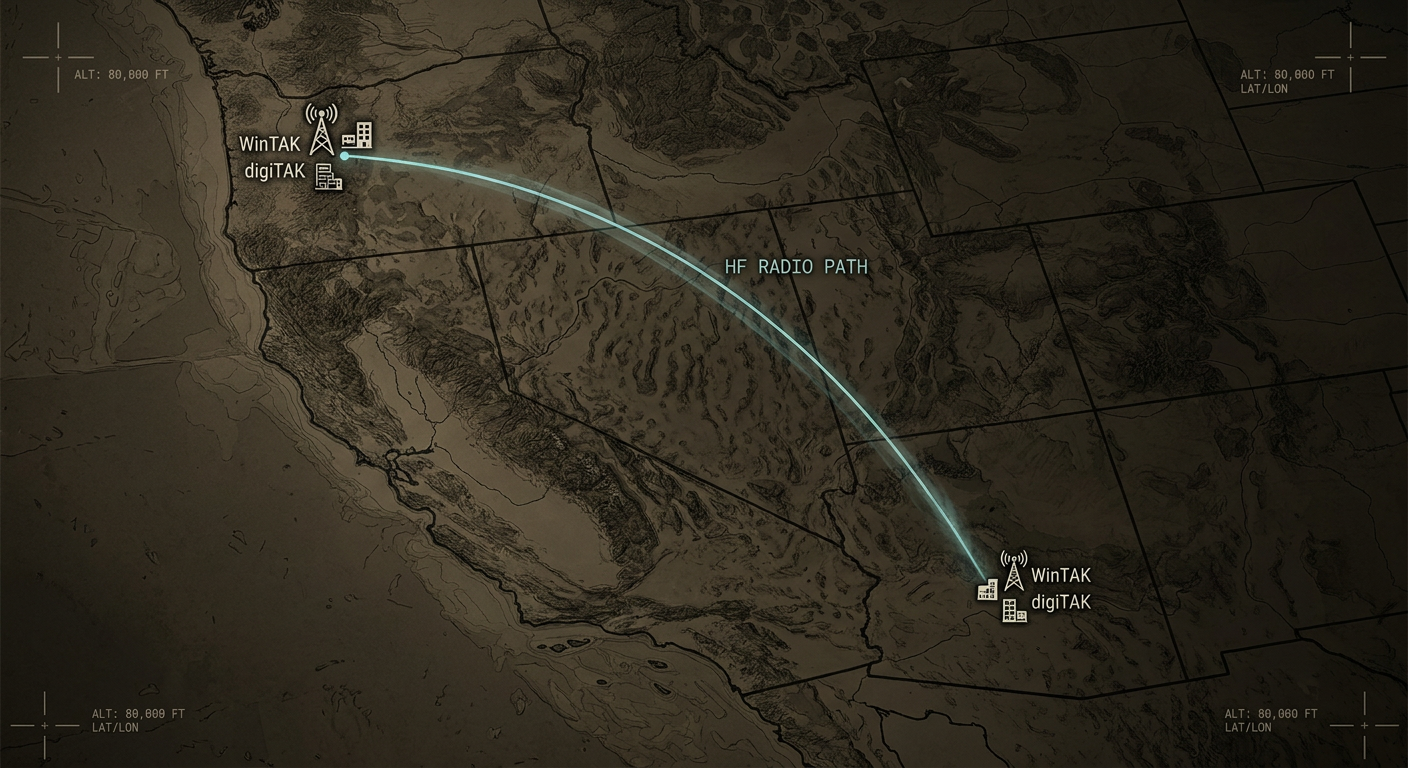
Stylized topographic map of the western United States with two state EOCs marked roughly 800 miles apart, connected by a cyan arcing HF radio path bouncing off the ionosphere, tactical HUD reticle markings at the corners
OUTCOME 05

Retire your legacy APRS app — any TAK client is the UI now

For ham operators tired of legacy APRS software — digiTAK is the modern replacement. The user interface is any TAK client: ATAK, WinTAK, iTAK, or baseTAK in a browser.

  • Any TAK client as your APRS UI — modern map providers, click-to-message, fast click paths.
  • Connect a USB GPS to the digiTAK and it becomes a mobile APRS tracker.
  • Every APRS station as a TAK contact — DM by callsign, bulletins, weather stations, the local APRS net.
  • Standard APRS wire format — digiTAK plays nicely with whatever else is already on the net.
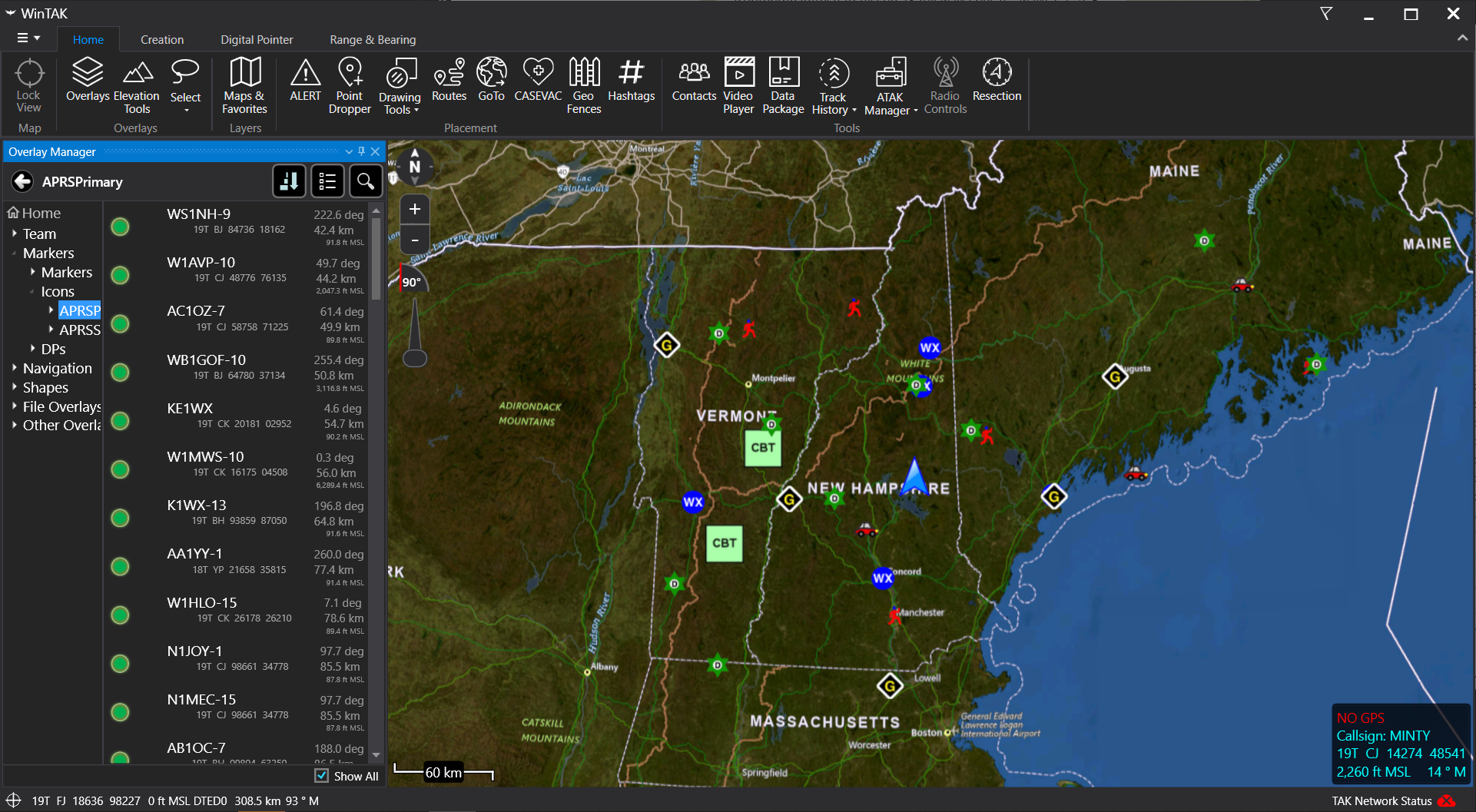
WinTAK on a Windows desktop showing APRS station contacts pulled in via digiTAK — Northern New England rendered on the TAK basemap with mountaintop digipeaters and weather beacons visible across VT, NH, and ME, and the Overlay Manager pane open on the left listing every APRSPrimary callsign

What's in the box.

digiTAK is a full APRS-to-TAK gateway that runs on its own appliance. The features below apply across both deployment shapes; the mode-specific extras follow. Bridge mode means baseTAK (and possibly other xTAK products) is already on the network with the digiTAK. Standalone mode means digiTAK is the whole TAK install.

▾ Shared across both modes
  • Direwolf-managed VHF/UHF with managed PTT (RTS, CM108, or VOX).
  • External TNC support via KISS over TCP or KISS Serial.
  • APRS-IS Tier 2 connection with auto-passcode derived from your callsign.
  • Open TAK-APRS Protocol Extension v2.3 — public spec at cot_radio_aprs.
  • Full digipeater with WIDE1/WIDE2 aliases, dedup window, own-echo filter, and sibling-gateway coexistence — multiple digiTAKs on one RF channel coordinate so they don't re-emit or re-digipeat each other's traffic.
  • IGate beacon on the gateway SSID (e.g. KN6ZPL-10) — broadcast on both RF and APRS-IS.
  • Operator TX-position beacon on the main SSID with SmartBeacon-gated motion-adaptive cadence (fast on highway, sparse at rest).
  • gpsd live-position — heading, course, speed, HAE flow through to gateway SA, IGate beacon, and TX-position. Static lat/lon fallback when gpsd is off.
  • TAK protobuf RX from other TAK gateways — peer-to-peer, no XML round-trip.
  • Full APRS icon set — every primary and alternate APRS symbol (digi, mobile, weather, ambulance, fire engine, boat, aircraft, mil unit, NWS object, etc.) maps to a proper TAK iconset path. An APRS station shows up on the map with its correct symbol — not a generic dot.
  • Iconset preservation across gateway echoes — APRS station icons keep their assignment when re-emitted by a sibling.
  • Marker UID CRC16 — keeps wire UIDs short while preserving uniqueness on the air.
  • Admin UI on port 5101 with live audio meters (RX + TX VU), packet feed, counters.
  • 1645+ pytest cases gating every release.
▾ Bridge mode — alongside the xTAK suite on the network

digiTAK runs on its own appliance as always, but talks to baseTAK and other xTAK products that are on the network with it. baseTAK owns the broader SA picture; digiTAK extends it onto amateur radio in both directions — no glue, no integration, just standard TAK protocols.

  • TAK → APRS broadcast bridging — markers, shapes, and chat on TAK get re-emitted onto APRS so plain-APRS receivers see them.
  • Mesh-to-APRS gating (gate_mesh_to_aprs) — forward mesh-origin SA and markers to APRS, or keep mesh traffic off RF entirely. Per-operator policy.
  • Datapackage notifications to APRS — when baseTAK ships an attachment, the announcement goes out on APRS too.
  • Group-origin prefix (prefix_group_origin) for outbound chats — receivers know which TAK group originated the message.
  • Bridge-v2-only filter (bridge_v2_only) — drop legacy plain-APRS inbound; only v2-protocol packets pass through. Useful for high-noise channels.
  • Configurable RF chatter level (bridge_aprs_chatter) — bridge the noisy stuff or keep the wire clean.
▾ Standalone mode — digiTAK alone is the whole TAK install

No baseTAK anywhere on the network. Just a digiTAK and the TAK clients that connect to it. digiTAK hosts its own chat router, TAK router, and APRS bridge — every ATAK / WinTAK / iTAK on the LAN connects directly and sees both the local team and APRS contacts from the wider world.

  • Self-contained chat router — handles GeoChat DM, team, and broadcast routing for the LAN even when baseTAK isn't on the network.
  • Self-contained TAK router — emits SA and chat directly to local TAK multicast so every WinTAK / ATAK / iTAK on the LAN sees the picture.
  • Bulletin subscriptions (BLN0–BLN9 + NWS wildcards like NWS-*, CAZ*, NMZ*) — selectively forward APRS bulletins to TAK, sticky in the admin UI.
  • StandaloneInboundHold — 5-min holding buffer (max 100 frames) for inbound APRS during boot, so nothing's dropped during the warm-up window.
  • Per-participant TCP fan-out for DM and team chat — replicates ATAK's TCP-unicast convention so DMs go directly to the recipient's endpoint.
  • R1–R19 gating completion — 19 explicit resolutions covering every inbound/outbound APRS scenario when there's no baseTAK on the network. Own-echo filter included.
★ Choose digiTAK when

The WAN is gone and the team is spread across counties. You have a ham, an appliance, and a 2-meter rig — that's enough. The wire is gone. The picture isn't.

☕ Beta · Early Access

Get digiTAK in your hands now.

Become a supporter on Buy Me a Coffee and join the early-adopter Beta — get the current build, the next release, and direct engagement with the team.

Support on Buy Me a Coffee

What digiTAK needs.

Modes
Bridge (federated multi-site mesh) and Standalone (single gateway)
VHF/UHF transport
Direwolf modem (bundled) or any KISS-compatible TNC (serial or TCP)
APRS-IS transport
Tier 2 (your callsign + passcode)
HF transport
Binary compression codec (~20 bytes per position) · future release
TAK clients
ATAK, WinTAK, iTAK, baseTAK — any standard TAK client
Wire protocol
TAK-APRS Protocol Extension v2.3 (open spec)
Hardware
Linux appliance (4 GB+), or any modern Linux box. Python 3.8+, systemd.
Installation
Offline tarball · all Python wheels vendored
Admin UI
Web, port 5101 · live audio meters, packet feed, counters
Version
v 2.1.12 (Beta · shipping soon)

Questions
operators ask.

Do I need TAK Server?

No. digiTAK talks to ATAK, WinTAK, and iTAK clients directly on your LAN. TAK Server is a separate product that federates clients across WAN — which is the problem digiTAK solves over RF instead.

Does it work with civilian (CivTAK) builds?

Yes. digiTAK speaks the same TAK protocol all builds use.

Do I need an amateur radio license?

For RF transmission, yes — digiTAK transmits on amateur frequencies and you need a licensed callsign. For APRS-IS-only operation you still need a valid callsign and passcode (free for licensed hams). HF operation requires the appropriate band privileges for your license class.

Can I keep my legacy APRS software alongside digiTAK?

Yes. digiTAK speaks the standard APRS wire format on the air. Whatever legacy APRS software you're running keeps working. digiTAK adds a modern TAK-client front end in addition to whatever you already run.

Can my digiTAK be a mobile APRS tracker?

Yes. Connect a USB GPS to the appliance and digiTAK beacons its own position as your APRS station. Mount it in a vehicle, throw it in a pack, or run it in your shack as a fixed beacon.

Can two digiTAKs run on the same LAN?

Yes. Each gets its own tactical callsign and station number; they coordinate, they don't collide.

When is HF support shipping?

HF transport via a binary compression codec is in active development — design is complete (FR-081) and implementation is in progress. Early Adopters get access as soon as it ships.